Maybe it's the couch, the old dresser, a broken treadmill, or a whole garage of mixed things. Which route fits depends on where your property sits in San Diego County, what the items are, and how they leave the space. This page compares the two routes and walks through what to sort first, what to keep, and what to ask.
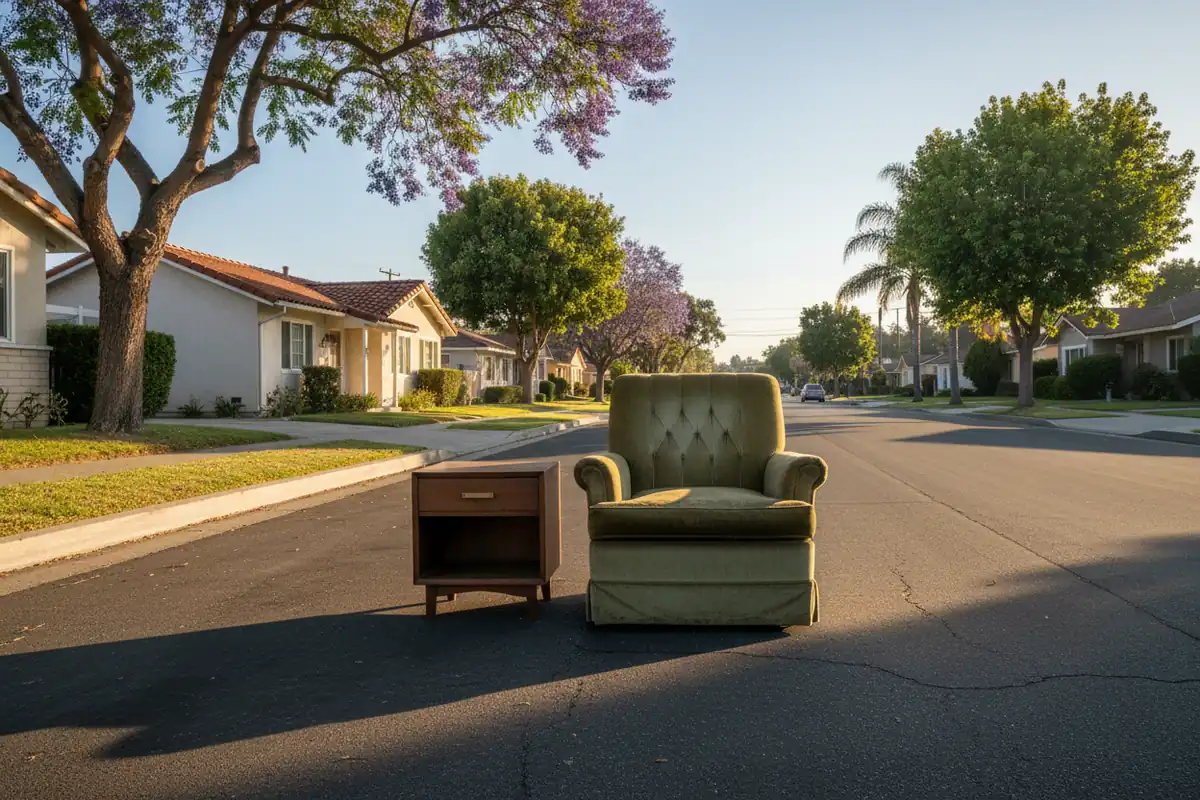
If you have a few large items that your city's program accepts, a city bulky item pickup may fit, where one exists. The City of San Diego does not run one. If you have a large volume, a mixed load, items a program excludes, or items that are hard to bring to the curb, a private hauler that loads from your property usually fits better.
On this page
What Each Service Covers
A bulky item pickup is a scheduled collection, run by a city or by the company that holds its trash franchise, for oversized household items that do not fit in a standard bin. Junk removal is a private service in which a hauling company loads unwanted items from your property and carries them away. Hauling is the broader word for the transport part of that work.
The two routes differ first in who offers them. The City of San Diego's Environmental Services page says: "Please note that the City of San Diego does not provide bulky item pickup or curbside pick-up services." If your property is inside the City of San Diego, there is no city bulky collection to book. Other cities in the county set up their own trash service. Whether your city has a bulky program, and what it accepts, is for that city or its franchise hauler to state. The Chula Vista junk removal page looks at one city's situation.
A private hauler is not tied to a single program's list. The job is defined by what you want gone and where the items go for disposal, recycling or donation. Junk removal in San Diego explains that process in more detail.
When a City Collection Makes Sense
A city or franchise collection fits a narrow set of jobs:
- A small number of items.
- Items that meet the program's size and type rules.
- A timeline that can wait for the program's scheduled date.
Eligibility starts with location. The program belongs to the city or service area your property is in, so a neighbor across a city line may have different rules or none. Your city's own trash page or its franchise hauler confirms whether your address qualifies.
Set-out rules also vary. Programs of this kind usually ask for items to be placed at the curb or another collection point by a stated time. The exact placement, timing and limits are the program's to set, so it helps to confirm them with the program rather than rely on a neighbor's experience or another city's rules.
A city collection may also cover only part of what is in your garage. Anything outside the program's accepted list needs another route, and that can mean splitting one cleanout across a city date, a drop-off and a hauler.
When a Hauler Fits the Job Better
A private hauler fits jobs that go beyond a curbside program's limits:
- Volume. A full garage, a rental unit between tenants, or a relative's home being cleared holds more than a curbside program is usually set up for.
- Mixed loads. Furniture, boxed household goods and yard debris can leave together, with any special-handling items flagged and separated.
- Excluded items. A program may leave out items such as construction debris, certain appliances or electronics. A hauler can be asked about these case by case.
- Access. Items in an upstairs bedroom, a back unit, or behind a gate can stay where they are. The hauler loads from inside the property, so nothing has to be carried to the curb.
- Timing. A move-out or a property handover may not line up with a program's calendar.
If you are an executor, a landlord or a property manager clearing a whole home or unit, your job is usually of this kind, mixed and sizable. The move-out cleanout and commercial junk removal pages describe those jobs. For single large pieces, furniture removal covers what is involved.
Availability, timing and price depend on your specific property, and a hauler puts them in writing for that job rather than quoting them sight unseen.
Items That Need Special Handling
Some items leave the property separately from everything else, whichever route you use.
| Category | What it means | How it is usually handled |
|---|---|---|
| Household hazardous waste | Leftover household products that can harm people or the environment, such as paint, chemicals, batteries and fluorescent bulbs | Kept out of a curbside pile or a general load, with drop-off confirmed through the county or city program |
| Electronic waste | Discarded electronics such as televisions, computers and monitors | Flagged, with the recycling route confirmed through the program that handles it |
| Appliances with refrigerant | Refrigerators, freezers, air conditioners and similar units with a cooling system | Flagged, because refrigerant recovery has its own federal standard |
| Construction and demolition debris | Material from building, remodeling or tearing out, such as drywall, lumber, tile and concrete | Checked against a program's list, and mentioned to a hauler up front |
| Green waste | Yard material such as branches, clippings and leaves | Checked against the city's green waste rules, or mentioned to a hauler as part of the load |
| Tires | Vehicle and equipment tires | Accepted route confirmed with the city or county program |
| Mattresses | Mattresses and box springs | Confirmed with the program or the hauler |
For a small appliance with refrigerant, 40 CFR 82.155 ("Safe disposal of appliances") calls for "recovery equipment that meets the standards in § 82.158(e) through (g)" when refrigerant is recovered for disposal. How that standard applies to a particular appliance is confirmed by the agency that administers it. For the other categories, the city or county program that handles each one states what it accepts and where.
What Affects the Cost
The cost of a city bulky collection, where your city has one, is set by that city or its franchise hauler. Some programs fold the collection into the trash service a household already pays for, while others charge separately. The city or hauler confirms which applies to your address.
For a private haul, the price comes from the job itself:
- Kind and number of items. A single sofa differs from a household's worth of furniture and boxes.
- Volume. This is how much space the load takes up in the truck.
- Weight. Dense material such as tile, concrete or exercise equipment changes the job.
- Access. Stairs, a long carry to the truck, tight hallways, a gated entry and parking all affect the work.
- Special handling. Items that go to a separate facility or need separate disposal add a step.
- Timing. A fixed move-out date or handover can shape the job.
A written quote sets the price for a specific haul, based on these factors. Quotes are easier to compare when each one is based on the same list of items and the same description of access.
How to Get Ready
Both routes start with sorting. Separating accepted items from special-handling items reduces the chance of a rejected pile or a second trip.
For a city collection, preparation usually covers:
- The address. Whether the property is in a city or service area with a bulky program.
- The accepted list. How each item compares with the program's own list.
- Set-out rules. Where items go and by what time, as the program states.
- Excluded items. Anything the program does not accept, moved to a separate spot.
For a private haul, preparation usually covers:
- Everything going. A walk through each room, the garage and the yard, noting what leaves.
- Special items. Paint, batteries, electronics and refrigerant appliances, marked so the hauler knows about them.
- Access. Stairs, gate codes, parking limits and any association rules worth checking.
- What stays. Papers, photos, keepsakes and anything a family member may want, moved out of the way of the load.
Keepsakes and documents can wait for a later, slower decision. Only the items that are actually ready to leave need to be part of this job.
Mistakes to Avoid
These missteps lead to a pile left on the curb or an item with nowhere to go:
- Setting out excluded items. Items a program does not accept may be left behind, and a curbside pile can draw a notice.
- Assuming the City of San Diego collects bulky items. Its Environmental Services page, quoted above, says it does not.
- Skipping the address check. City lines and service areas decide which program applies, if any.
- Mixing hazardous waste or electronic waste into a general load. Unflagged, these items have no route out with the rest.
- Assuming a hauler takes everything. Refrigerant appliances and household hazardous waste have separate requirements, so they are worth raising when the quote is requested.
A practical starting point is the trash service page for the city or area where your property sits. That page shows whether a bulky program exists and what it accepts, and whatever is left over becomes the starting point for a hauler's quote.
Ready for a quote?
Add the items, the address and your timing.
Get my junk removal quoteFrequently asked questions
How do I dispose of large items in San Diego?
It depends on where the property is. Some cities in the county may offer a bulky collection through their franchise hauler, but the City of San Diego does not. A private hauler is the other route. Special-handling items such as hazardous waste, electronics and refrigerant appliances need a separate path on either route.
Does the City of San Diego offer bulky item pickup?
No. The City of San Diego's Environmental Services page says the City "does not provide bulky item pickup or curbside pick-up services." Other cities in San Diego County set their own trash service, so whether a program exists is confirmed with each city or its franchise hauler.
What is the difference between junk removal and hauling?
The two terms describe much the same private service: a company loads items from a property and carries them away. Junk removal usually means the full load-and-haul job, while hauling is the broader word for the transport part. Both differ from a city bulky collection, which is scheduled and set out at the curb.
What items does a city bulky item program accept?
Accepted items vary by city and franchise hauler, so the program's own list is the one that counts. Large household items are the usual focus of these programs. Household hazardous waste, electronic waste, construction debris, tires and refrigerant appliances are the categories to check with particular care.
What happens to items that need special handling, like old refrigerators or paint?
They leave separately from the general load. For a small appliance with refrigerant, 40 CFR 82.155 calls for "recovery equipment that meets the standards in § 82.158(e) through (g)" when refrigerant is recovered for disposal. Paint and other household hazardous waste go to the program that handles that waste, and the county or city program confirms where to take it.
What affects the cost of hiring a hauler?
The cost depends on the kind and number of items, the volume, the weight, access to the items (stairs, carry distance, gated entry), any special handling, and the timing. A written quote sets the price for the specific job.