A garage, shed or rental clearout often turns up a shelf of half-used paint, a propane cylinder from an old grill, and a box of loose batteries. Those items do not have to stop the job. They leave the property by a different route from the furniture, boxes and debris, and the local program that collects them decides what it accepts and how.
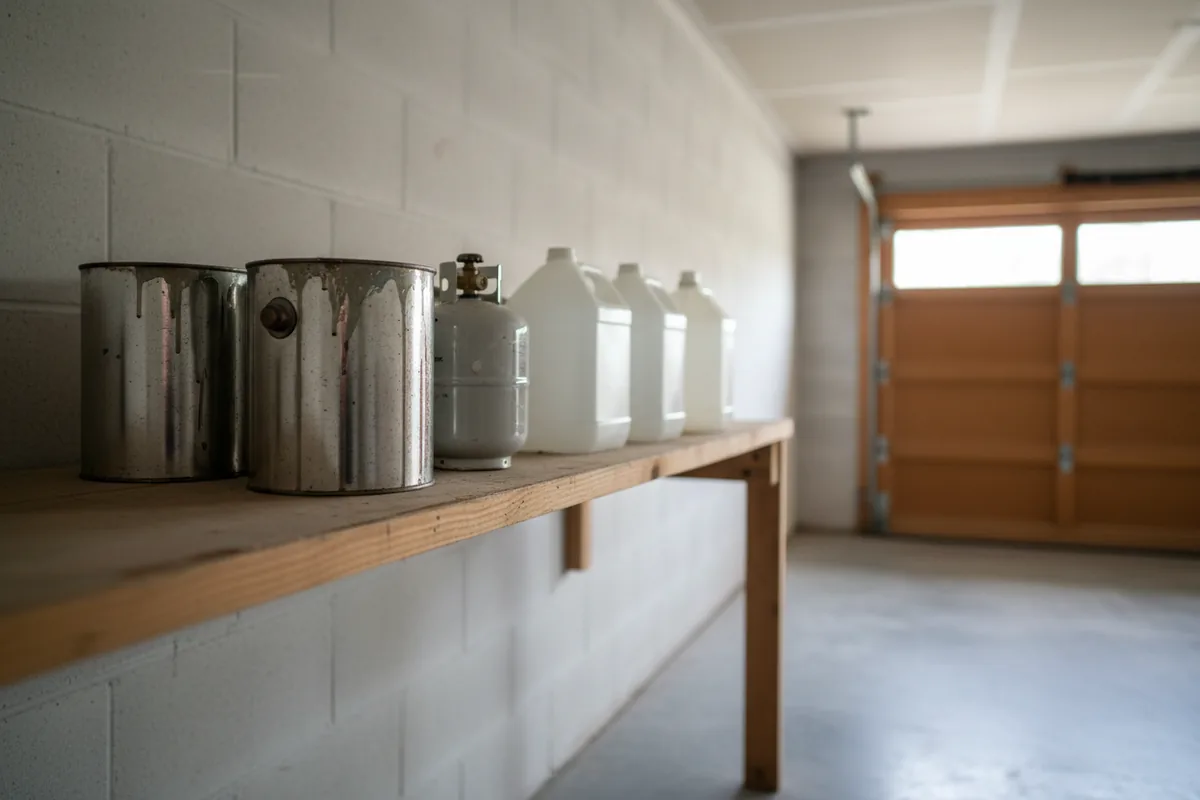
A junk hauler in San Diego County typically leaves paint, solvents, propane tanks, batteries, pesticides, pool chemicals, motor oil and similar materials out of the truck. These are household hazardous waste, and they go through a separate collection channel instead of the general load. Setting them aside first keeps the rest of the cleanout moving.
On this page
What It Covers
Household hazardous waste, often shortened to HHW, means leftover products from a home or small business that are flammable, corrosive, toxic or reactive. Junk removal, the hauling away of unwanted items and debris, covers the general load. HHW is the part a hauler typically sets apart.
The broad categories that come up in a clearout are:
- Paints, stains and solvents, including thinners and strippers.
- Compressed gases, such as propane tanks and camp canisters.
- Batteries of all kinds.
- Pesticides and herbicides from the garden shelf.
- Pool and spa chemicals.
- Motor oil and automotive fluids.
- Mercury-containing items, such as older thermostats and fluorescent bulbs.
Paint has its own collection framework in California law. Health and Safety Code section 25217 refers to recyclable latex paint and oil-based paint "initially collected at a collection location" and transported to a "consolidation location," and it treats water-based latex paint "still in liquid form" as recyclable latex paint. In practice, the collection site that receives a can decides whether it qualifies.
When It Makes Sense
Handling HHW separately fits any job where these products are mixed in with ordinary junk: a garage cleanout, an estate cleanout, a move-out, or a business clearing a storage room. A business clearing a workspace may find that commercial junk removal and its own hazardous products follow different paths.
Haulers usually refuse these materials because a general truck, and the transfer station it unloads at, are set up for ordinary waste. A transfer station is a facility where collected waste is sorted before it goes on to disposal or recycling. Leaking, flammable or pressurized containers call for a different kind of containment and handling. The refusal reflects a practical and regulatory limit rather than reluctance, and each facility publishes its own list of what it will take.
Items That Need Special Handling
Some items sit between categories, and the answer depends on the program receiving them:
| Item | Why it needs a check |
|---|---|
| Small propane camp canisters | Size and condition may change which drop-off accepts them |
| 20 lb grill tanks | Some may be exchanged or refilled; others go to a collection program |
| Car batteries | Handled differently from household batteries in many programs |
| Fluorescent bulbs | Contain mercury, so they stay out of the general load |
| Microwaves and small electronics | Electronic waste, meaning discarded devices with circuitry, may follow its own channel |
| Tires | Usually a separate channel; see tire disposal in San Diego |
Garden waste is a different matter again. Leaves, branches and clippings are green waste, covered under yard waste removal, but the weed killer and fertilizer stored beside them are HHW. For the gray-area items in the table, the local program's accepted-materials list holds the answer.
What Affects the Price
A hauler's written quote covers the general load: the kind and amount of items, their weight, stairs and the distance to the truck, how the items are disposed of, and the timing. Hazardous products set aside before the pickup are usually not part of that load, so they do not shape its quote.
Any charge a collection program makes is listed on that program's own page. When a few HHW items turn up mid-job, they are usually left on site for a separate drop-off rather than added to the truck.
How to Get Ready
A clean separation keeps the pickup simple and keeps the hazardous items contained until they reach a collection site. The steps below describe how that separation is commonly done.
- HHW pulled out first. Paint, chemicals, propane and batteries are gathered in one spot away from the general load.
- Original containers kept. A labeled can or bottle tells the collection site what is inside.
- Products left unmixed. Combining leftovers can cause reactions and makes identification harder.
- Lids closed and containers upright. This limits leaks while items wait.
- Battery terminals taped. Covered terminals are less likely to short against each other.
- The hauler told what is set aside. That way nothing in the HHW pile ends up in the truck.
- Papers and keepsakes set aside too. Documents and anything a relative may want belong in their own pile, not the load.
For a property in the city itself, junk removal in San Diego describes what the City does and does not pick up. In other cities, such as junk removal in Santee, the city's own pages state its rules. The usual next step is the HHW collection page for the property's city, with its accepted-materials list, hours and any appointment requirement.
Mistakes to Avoid
A few errors cause most of the trouble with leftover chemicals.
Putting HHW in the trash or recycling bin. Ordinary carts end up at the same kind of facilities as a hauler's truck, so they are not a workaround.
Leaving items at the curb. The City of San Diego's Environmental Services page states: "Please note that the City of San Diego does not provide bulky item pickup or curbside pick-up services." Where another city offers a pickup, it accepts only what its own pages describe.
Handing HHW to anyone who offers to "take care of it." Hazardous materials move under their own handling rules, and an ordinary load is not that channel.
Pouring products together or peeling off labels. Mixed or unlabeled containers are harder for a collection site to identify.
Treating every battery or paint can alike. Car batteries, household batteries, latex paint and oil-based paint may each go to a different place.
Ready for a quote?
Add the items, the address and your timing.
Get my junk removal quoteFrequently asked questions
What are the main categories of household hazardous waste?
The list in the "What It Covers" section above sets out the categories. The common thread is that each product is flammable, corrosive, toxic or reactive, which is why it is kept out of the general load.
How do you dispose of old 20 lb propane tanks in San Diego County?
Condition usually decides the route. A tank in usable shape may be exchanged or refilled, while others go to a household hazardous waste collection program; either way it stays out of the trash and out of a hauler's truck. The retailer that sold the tank is another place to ask.
Where do I dispose of batteries in San Diego?
The answer depends on the battery type. Household batteries and car batteries may go to different channels, as the table above shows, and neither belongs in the trash or the general load. Taping the terminals keeps them safer until drop-off.
Where can I dispose of household hazardous waste near me in San Diego County?
Drop-off locations, hours and appointment rules are set city by city. The household hazardous waste page for the city where the property sits is the starting point, as the preparation section describes.
How do I dispose of large items in San Diego that a hauler won't take?
Two separate questions are involved. Hazardous items a hauler refuses go to a household hazardous waste program. Large ordinary items, such as furniture, go with the general load or, where a city offers one, its own pickup. The City of San Diego's page states it does not provide bulky item or curbside pickup.