A hot tub may be sitting on a patio or deck you are clearing. It may be your own yard, a rental you manage or a relative's home. The questions that decide how it leaves are practical ones: is it empty, is the power off, and can it fit through the path to the street? The sections below go through each one, along with what to set aside and what shapes a quote.
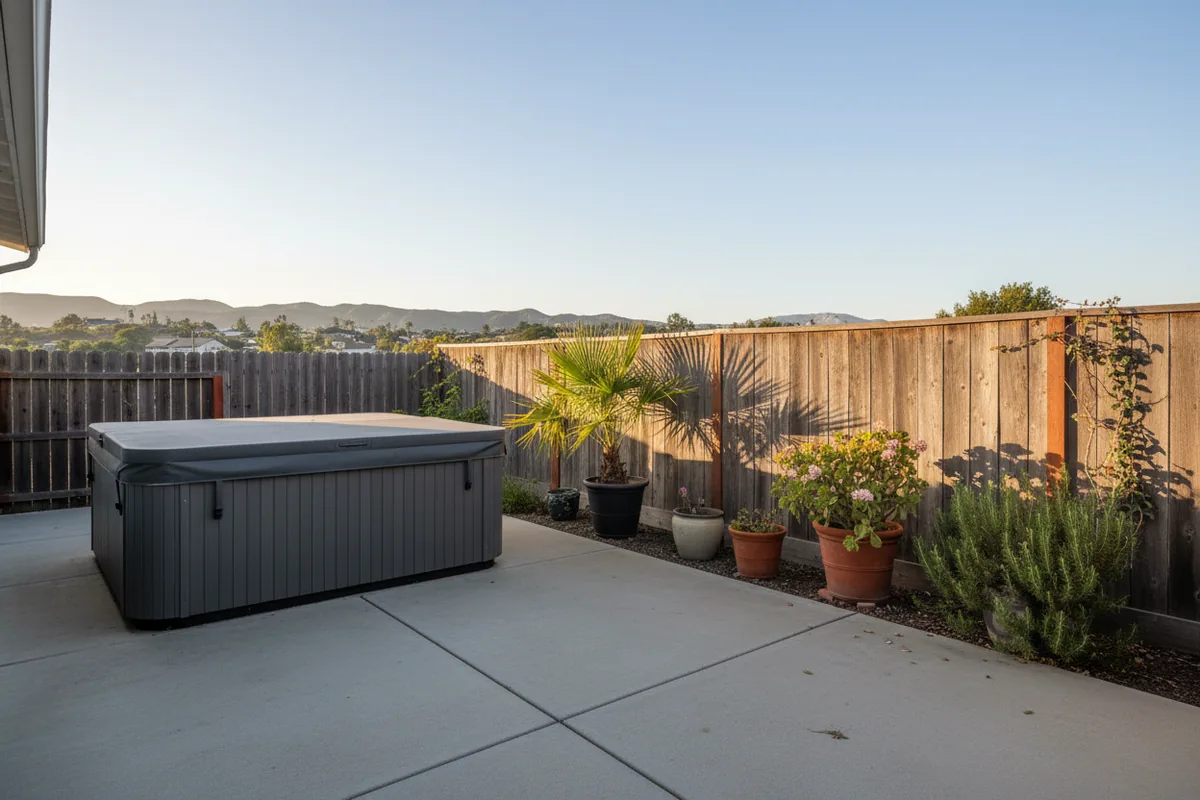
An above-ground hot tub or spa in San Diego County is usually removed in three stages. First it is drained and its electrical supply is disconnected. Then it is cut into sections if it will not fit through the gate or side yard. Finally the pieces are hauled away for disposal, recycling or scrap, depending on what the receiving facility accepts.
On this page
What Hot Tub Removal Covers
Hot tub removal means disconnecting an above-ground hot tub or spa, breaking it down if needed, and hauling it away from the property. It is one kind of junk removal in San Diego County, which is the general work of hauling unwanted items off a property.
A hot tub is a bulky item. That means it is an oversized item, too large for standard curbside collection. Portable and above-ground units sit on a pad or deck. They can often be lifted whole if the path allows.
When a gate, fence, narrow side yard or set of steps is in the way, the shell is cut into sections on site. An in-ground spa is a different job. Its scope can include excavation and backfill, and it is scoped separately from a portable unit.
When Hot Tub Removal Makes Sense
The situations that lead to removal include:
- a unit that no longer heats or holds water
- a backyard remodel or deck replacement
- a rental turnover
- an estate clearance
- a broader property cleanout
A tub left in place can hold up the rest of a cleanout or a move-out. That is because it sits where other work needs to happen, and it is often the largest single item in the yard.
A working hot tub may still have resale value to someone who wants it. A unit that does not work has metal parts, such as the pump, heater and frame, that may have scrap value. Whether either one changes the cost of removal depends on the unit's condition and the hauler's assessment. It is not a promise. What happens to the house is a separate decision, and clearing the yard does not require selling it.
Items and Materials That Need Special Handling
Electrical connection. A hot tub is often hardwired to its own circuit. Disconnecting it is electrical work, and electrical work can fall under permit and code requirements. In the City of San Diego, the Development Services Department confirms what a disconnection requires. In other cities in San Diego County, that city's building department confirms it.
Water. The tub has to be drained first. Where the water may go, such as a sewer cleanout, a landscaped area or a street gutter that leads to a storm drain, can be subject to local stormwater rules. The city or county stormwater program confirms how those rules apply to a specific property.
Spa chemicals. Chlorine, bromine and pH adjusters are household hazardous waste. That term means materials that are toxic, flammable, corrosive or reactive and are kept out of the regular trash. The San Diego County household hazardous waste program, or the city's own program, states where these chemicals are accepted.
Shell, cabinet and foam. The fiberglass or acrylic shell, the wood or composite cabinet, and the foam insulation are generally handled like construction and demolition debris. That term means waste from building, renovation or demolition work. The facility that receives the debris states what it accepts.
What Affects the Price
A written quote for hot tub removal is shaped by a handful of factors, set out in the table below. Junk removal pricing works on the same principle for other items: the quote follows the specific job.
| Factor | Why it matters |
|---|---|
| Size and weight | Larger units take more labor and more truck space |
| Cutting down | Sectioning the shell adds work and tools |
| Distance to the truck | A long carry from the backyard adds labor |
| Stairs, slopes, decks | Elevation changes make the lift harder |
| Electrical disconnect | May be done by an electrician separately from the haul |
| Disposal route | Landfill, recycling and scrap each have their own costs |
Disposal fees at San Diego County transfer stations and landfills are set by each facility's fee schedule. A transfer station is a site where loads are dropped off before going on to disposal or recycling. Self-hauling to one of these facilities is also subject to its fee schedule, and the facility confirms the current rate.
Some haulers offset part of the cost against the scrap or salvage value of a unit's components. That is one input to a quote, not a promise of free removal.
How to Get Ready for Hot Tub Removal
Preparing the tub and the path around it is what most affects how smoothly removal goes. The checklist below covers the steps in order.
- Drain the tub completely. Plan the draining for before the removal date, because an empty shell is far easier to move.
- Arrange the electrical disconnection. Have a qualified electrician handle it if needed; the building department for the property's city confirms whether a permit applies.
- Store spa chemicals separately. Keep them apart from the unit, and check the county household hazardous waste program for where they go.
- Clear and measure the path. Note the gate width, any stairs, low eaves and anything locked that the hauler will need to pass through.
- Check association or property rules. Look up any homeowners association or property management limits on hauling vehicles or where debris can be staged.
- Ask about a street-bin permit. This is a permit to place a debris container in a public street or right-of-way, and the city's public works or engineering department confirms when one is needed.
Hauling generally follows the same steps as any other junk hauling in San Diego County. Those steps are an on-site look at the job, a written quote, and then the pickup.
Mistakes to Avoid
Leaving water in the tub. Water in the shell adds a great deal of weight, and a full or partly full tub may not be safe to load.
Assuming curbside pickup will take it. Bulky-item programs have limits on item size and type. The program for the property's city, where the city runs one, confirms what it accepts; the San Diego junk removal page covers the City of San Diego.
Leaving the power connected. If the electrical connection has not been dealt with, the job can stop before it starts.
Not measuring the path. A tub that cannot pass through whole has to be cut down. That changes the scope of the job and the quote.
Sending chemicals out with the shell. Spa chemicals go to household hazardous waste channels, not to the regular trash or out with the unit.
Skipping the lease or association rules. A rental agreement or an association's rules may limit when, or how, removal can take place.
A practical next step is to find the breaker label for the tub's circuit at the electrical panel and pull up the association's or the lease's rules on hauling. Measuring the narrowest point between the tub and the street is a useful step at the same time.
Sources
The offices named on this page state and confirm their own rules, accepted materials and fees: the City of San Diego Development Services Department, city building and public works departments, local stormwater programs, the San Diego County household hazardous waste program, and the transfer stations and landfills in San Diego County.
Ready for a quote?
Add the items, the address and your timing.
Get my junk removal quoteFrequently asked questions
How much does it cost to have a hot tub removed?
No fixed price applies. The cost follows the unit's size, whether it must be cut down, the access to it, how the electrical disconnection is handled, and the disposal route. Facility disposal fees are set by each facility's fee schedule. A written quote sets out the figure for a specific property.
How do I get rid of my old hot tub?
There are three main routes: arrange a pickup through a hauler, self-haul it to a San Diego County transfer station or landfill under that facility's fee schedule, or offer a working unit for resale or scrap. Each route starts with draining the tub and disconnecting the power. How junk removal works covers the general hauling route.
Are hot tubs worth scrapping?
The pump, heater and frame contain metal that may have scrap value, and some haulers factor that value into their pricing. Whether it offsets the cost of removal depends on the unit's condition and the hauler's assessment. An offset is not assured.
Can I take a hot tub to the dump for free?
Self-haul disposal at San Diego County transfer stations and landfills is subject to each facility's fee schedule, and the facility confirms the current rate. The tub needs to be drained before transport, and the spa chemicals are handled separately as household hazardous waste.
Do city bulky-item pickup programs take hot tubs?
Bulky-item programs set their own limits on item size and type. The City of San Diego, or another city in the county, confirms whether it offers a bulky-item pickup and whether a hot tub qualifies.
Do I need a permit to remove a hot tub in San Diego County?
It depends on how the tub is wired. A hardwired connection may call for a permit for the disconnection work, which the city's building or development services department confirms. A street-bin permit for a debris container is a separate question, confirmed by the city's public works department.
Does a hot tub need to be drained before removal?
Yes. Water adds substantial weight and makes loading unsafe. Where the water may be drained can be subject to local stormwater rules, which the city or county stormwater program confirms.