Maybe the piano is in your own living room, a relative's house, a rental between tenants or a condo with a shared elevator. Wherever it sits, the decisions that matter come early: whether anyone wants the instrument, whether it fits through the path out, and whether any part of it needs separate handling. Once those are settled, the rest tends to fall into place.
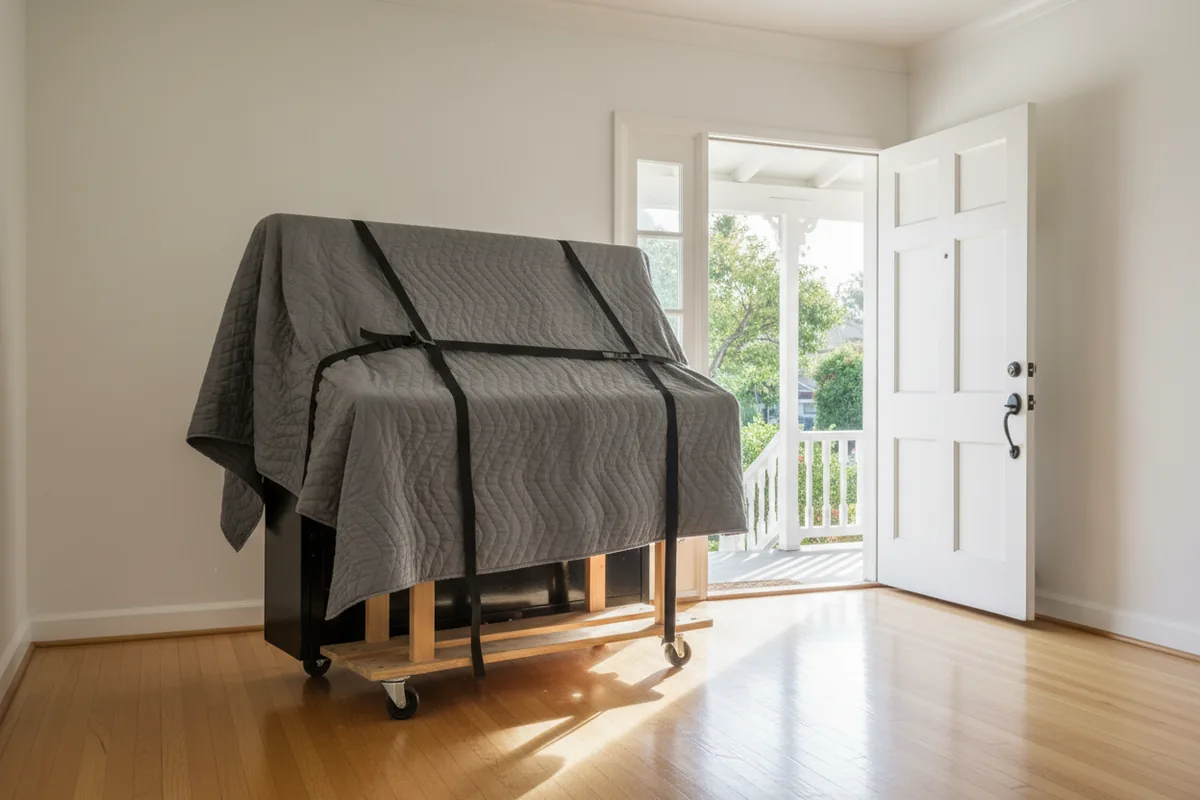
An unwanted upright or grand piano in a San Diego County home can usually be hauled away by a junk removal service. The instrument is carried out whole or taken apart on-site, then donated, recycled in parts or taken for disposal. The piano's type, the stairs and doorways, and where it ends up decide how it leaves.
On this page
What Piano Removal Covers
Piano removal means moving an upright or grand piano out of a home or commercial space and arranging for it to be donated, recycled or disposed of. It is a kind of junk removal, the hauling away of unwanted items, and it differs from piano moving, which relocates a playable instrument to a new address. This page is about pianos that are leaving for good.
Two main types are involved:
- Upright pianos: spinet, console, studio and full upright models.
- Grand pianos: baby grand, parlor grand and concert grand models.
Their size and footprint differ a great deal. A piano is a bulky item, meaning a large piece that does not fit in a household bin, and its weight and internal frame put floors, walls, doorframes and stairs at risk of damage. Whether your address is in El Cajon, Chula Vista or downtown San Diego, the property's own stairs, elevator and parking shape the job.
When Piano Removal Makes Sense
Removal tends to fit when no one in the family wants the piano and no buyer has come forward. Typical situations include:
- An estate cleanout.
- Downsizing to a smaller home.
- A piano that no longer plays or holds a tuning.
- A piano that has sat unplayed for years.
- A move to a place that cannot fit the instrument.
- A rental property turnover.
Condition matters. Schools, churches and community groups sometimes accept pianos, but a piano in poor structural or tonal condition is unlikely to find a taker. A piano with resale value may be worth listing privately first; removal is the path when no buyer appears or the timing does not allow a private sale.
Municipal pickup is not an option everywhere. The City of San Diego's Environmental Services page says: "Please note that the City of San Diego does not provide bulky item pickup or curbside pick-up services."
Items That Need Special Handling
Parts of some pianos raise questions beyond hauling the frame.
Ivory keys. Some older pianos have ivory keytops. Ivory can be subject to legal limits, and the wildlife agency that oversees those rules is the place to learn how they apply to a particular instrument.
Lead in older finishes. Finishes on some older instruments may contain lead. This matters mainly when a piano is broken apart on-site rather than carried out whole; the local environmental health office can explain how such material is handled.
Electronic parts. Player pianos and digital pianos contain electronics that may count as electronic waste, or e-waste: discarded electronic devices that are handled apart from ordinary trash. The receiving program or facility can say whether a given part qualifies.
The cast-iron plate and strings. The plate inside an acoustic piano is very heavy on its own. If the piano cannot leave whole, how it is taken apart depends on access, and the metal parts may go to a scrap channel, as scrap metal removal describes.
What Affects the Price
No single price applies, because each piano and each property differ. A written quote accounts for:
| Factor | What a hauler asks about |
|---|---|
| Piano type and size | Upright or grand, and which model within that type |
| Weight | How heavy the instrument is, which follows from its type and frame |
| Stairs | How many steps, and whether they turn or narrow |
| Doorways and halls | Widths along the whole path out |
| Elevator | Whether a building has one and whether it fits the piano |
| Distance to the truck | How far from the room to where a vehicle can park |
| Disassembly | Whether the piano must come apart to leave the building |
| Destination | Donation drop-off, recycling of parts or disposal at a transfer station, a site where loads are sorted before landfill |
| Timing | Whether the date is fixed or flexible |
A piano rarely leaves alone; other pieces in the same room, handled as in furniture removal, can change the job. A written quote is the reliable way to get a figure specific to your property and your piano.
How to Get Ready
Preparation is mostly measuring and deciding. Each step below makes a quote request clearer.
- Identify the piano. Whether it is upright or grand, roughly how old it is, and whether it has ivory keys or electronics.
- Measure the path. Doorframe, hallway and staircase widths, the number of steps and the distance to the nearest exterior door.
- Check parking. Whether a vehicle can stop at the curb or in the driveway.
- Review the building rules. Any association or building rules on move-out times or elevator reservations.
- Settle on a destination. Donation, if the piano is playable and a recipient agrees, or disposal or recycling of parts.
- Gather related papers. Purchase records or documents tied to ivory keys or other regulated parts.
- Confirm outside timing. Whether a property manager or escrow officer has a cleared-by date.
- Set aside keepsakes. Sheet music, photos and anything else in the bench or the piano that someone may want.
Other items leaving at the same visit, such as a fridge covered under appliance removal, are worth listing too.
Mistakes to Avoid
A few practical missteps tend to complicate a piano's exit from a home.
Assuming a donation will be accepted. Recipients often have limited space and specific condition requirements. Confirming acceptance first avoids carrying a piano to a place that turns it away.
Planning around a city pickup that does not exist. Within the City of San Diego, bulky item pickup is not available, as noted above. If you live in another city in the county, that city confirms whether it offers a pickup.
Underestimating the path. A piano that fits in a room may not fit through a hallway or down a turning staircase without being taken apart.
Leaving it to the last day. A piano often needs more coordination than ordinary pieces such as a sofa in couch removal, so a move-out or cleanout date with room around it helps.
Skipping the regulated parts. Ivory keys and electronics are easier to sort out with the relevant agency first than at pickup.
A useful next step is a walk from the piano's room to the street with a tape measure, noting each doorway, the stair count and where a vehicle can park, along with whether the keys might be ivory.
Ready for a quote?
Add the items, the address and your timing.
Get my junk removal quoteFrequently asked questions
How much does it cost to remove and dispose of a piano in San Diego?
No fixed price applies. Cost depends on the piano's type and weight, the stairs, the doorways, the distance to the truck, whether it must be taken apart and where it ends up. A written quote specific to the property and the piano is the reliable way to get a figure.
Where can I donate a piano in San Diego?
Donation is an option when the piano plays and holds a tune. Schools, churches and community organizations sometimes accept pianos, but each has its own condition and space requirements. Contacting a possible recipient directly and confirming acceptance comes before scheduling removal.
How do I dispose of an unwanted piano in San Diego?
Three paths exist: donation, if a recipient confirms acceptance; hauling for disposal through a transfer station or landfill; or taking the piano apart so its metal parts can go to recycling. A junk removal service arranges the logistics of whichever path applies.
Does the City of San Diego pick up pianos as bulky items?
No. The City of San Diego's Environmental Services page says the City does not provide bulky item pickup or curbside pick-up services, so residents of the City of San Diego arrange private removal.
Can a piano be removed from an upstairs room or a condo?
Yes, though stair count, hallway and doorframe widths, elevator size and parking decide whether it leaves whole or in parts. Measuring the path and checking building rules before requesting a quote helps the job be planned accurately.
What happens to a piano that cannot be donated or sold?
It is typically hauled for disposal, or taken apart so the cast-iron plate, strings and other metal can go to recycling separately. Which path applies depends on what the receiving facilities accept, and the quote reflects that path.
Do old pianos with ivory keys need special handling?
They can. Ivory may be subject to legal limits, and the wildlife agency responsible for those rules confirms how they apply to a given instrument. Settling that question before disposal keeps the pickup straightforward.