Perhaps you are standing in a garage stacked to the rafters, a rental unit a tenant has just left, a relative's home or a kitchen halfway through a remodel. The question is who will do the lifting, how long the work will run, and whether a container can sit where the job is. This guide walks through both options for properties in San Diego County, so you can match the service to the space.
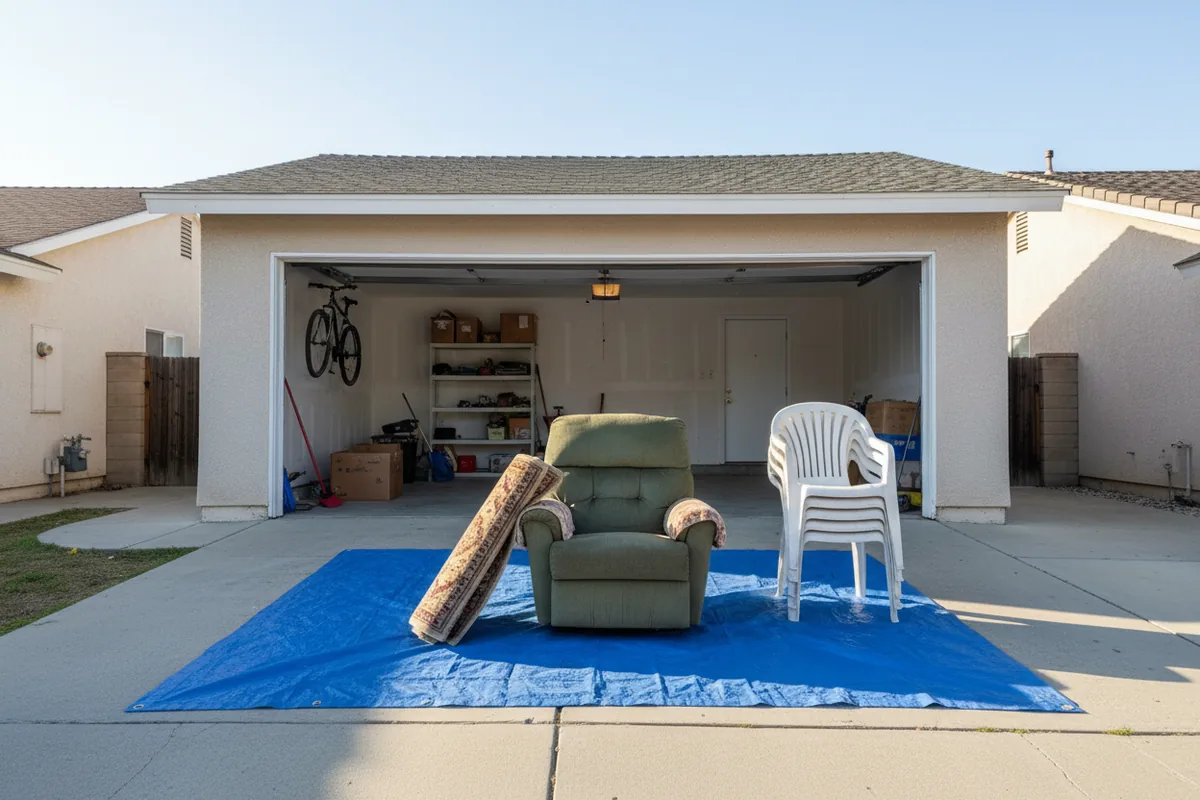
A dumpster rental puts an empty container at your property so you can fill it yourself over a set rental period. Junk removal sends a crew that loads the items and takes them away in one visit. A long project you load yourself usually suits a dumpster. A one-time clear-out someone else loads suits junk removal.
On this page
What Each Service Covers
A dumpster rental, also called a roll-off rental, is a large open-top container. A truck rolls it off at the property and leaves it there for the rental period. The renter fills it, and the company then hauls it away. The renter does all of the sorting, carrying and loading.
Junk removal, also called hauling or a hauling service, works the other way around. A crew comes to the property, carries the items out of the house, garage or yard, loads them onto its own truck and leaves with them. Nothing stays on the driveway once the visit ends. The general steps appear in this outline of how junk removal works.
Both services are often used for a cleanout, which means clearing an entire space, such as a garage, a whole home or a rental unit, of unwanted items. Both handle bulky items and debris. The real differences are who does the loading and how long a container stays at the property. Across San Diego County, the same question decides most of the choice: is the job a stretch of work you will do yourself, or one pickup handled by someone else?
Container size and rental length
Two questions usually follow once a dumpster looks like the right fit: how big the container should be, and how long it can stay. Roll-off containers come in more than one size, and the rental period is set by each company. Both appear in the company's written quote, and both feed into the price, as the pricing section below explains. A container that is too small for the volume is one of the common reasons items get left behind.
When Each Option Makes More Sense
A dumpster rental tends to suit work that runs over time:
- A renovation that produces debris as walls, flooring or cabinets come out.
- A large cleanout that the family or owner wants to sort at its own pace.
- A project with a large, fairly predictable volume of similar debris.
Junk removal tends to suit a different set of situations:
- One clear-out of a garage, a unit or a few rooms, with nothing left behind afterward.
- A household where no one can safely lift a sofa, a dresser or an appliance.
- A mixed load of furniture, appliances, boxes and odds and ends.
- A property where a roll-off container has nowhere to sit.
Access often settles the question at San Diego County properties. A narrow or steep driveway, a hillside lot, a low overhang or a shared parking area may leave no safe place for a container or the truck that delivers it. A homeowners association or a building manager may have rules about containers, and those rules are worth reading first. A bin that would sit on a public street or sidewalk may need a permit. The city, or the county for an unincorporated area, confirms whether one is required and what it involves. Owners of shops and offices face similar access questions, which are discussed under commercial junk removal.
Items That Need Special Handling
Some materials come out of the pile before anything is loaded, whichever service is used. What a dumpster company or a hauler accepts varies by service and by the rules of the disposal facilities that receive the load, so each item below is worth confirming first.
| Category | What it means | What to do |
|---|---|---|
| Household hazardous waste | Paints, solvents, pesticides, batteries, fluorescent bulbs and similar household chemicals or materials | Set aside and confirm the disposal channel |
| Electronic waste | Televisions, computers, monitors and similar devices | Set aside and ask whether the service takes them |
| Appliances with refrigerant | Refrigerators, freezers, air conditioners | Ask how the refrigerant is handled |
| Construction and demolition debris | Concrete, drywall, roofing and lumber from renovation or demolition | Ask whether it can be mixed with other items |
| Green waste | Yard trimmings, branches, grass clippings | Ask whether it is loaded separately |
| Mattresses and tires | Bedding and vehicle tires | Confirm whether they are accepted |
Appliances that contain refrigerant fall under federal rules. For a small appliance, 40 CFR 82.155 ("Safe disposal of appliances") calls for "recovery equipment that meets the standards in § 82.158(e) through (g)" when refrigerant is recovered for disposal. The hauler or the program that receives the appliance confirms how it handles that step.
This is also the point to keep anything that belongs to someone else. Papers, photographs, keepsakes and items a relative or tenant may want can go in a box marked "keep," away from the load. That decision can wait; the hauling cannot easily be undone.
What Affects the Price
Neither service has one set price. A written quote sets out the figure for a specific property and load, and the factors behind it differ for each option.
For a dumpster rental, the main factors are:
- The size of the container.
- How long the rental lasts.
- The type of debris. Construction and demolition debris, green waste and mixed loads may be priced differently.
- Any charge if the load goes over the weight included in the rental.
- How far the property is from the company's yard within San Diego County.
For junk removal, the main factors are:
- The volume and weight of the items.
- How many people the job needs.
- Access, including stairs, narrow hallways and the distance from the items to the truck.
- Items that need special handling.
Both services pay disposal fees at the transfer stations and landfills that take the load. A transfer station is a facility where collected waste is dropped off and sorted before it moves on to recycling or disposal. Those fees are set by the county or the facility, and they show up in the quote. A street permit for a container, where one is needed, adds its own cost, and that varies by city within San Diego County. The pricing guide covers these factors in more detail.
How to Get Ready
Some of the work before the pickup or delivery is the same for both services, and some depends on which one is chosen.
Sizing up the load. Rough counts of furniture, appliances, debris and boxes shape any quote. Anything from the special-handling table is easier to discuss once it sits apart from the rest. Documents and keepsakes go in the keep box, out of the work area.
Checking the site. Driveway width, overhead clearance for a roll-off truck and available parking decide whether a container can be placed at all. For junk removal, stairs, narrow halls and anything that has to be taken apart affect the quote instead.
Checking the rules. An HOA or a property manager may limit containers, work hours or truck access. For a container on a public street, the city or county office confirms whether a permit is needed.
Describing the space. A garage, a full home, a rental unit and a commercial space each call for a different description, along with the address.
In practice, this often comes down to a short walk-through with a notepad and a tape measure: the driveway, the gate, the stairs, and a list of anything that needs separate handling. For a container placed on a street, the city's or county's right-of-way rules are the record to check.
Where Projects Commonly Go Wrong
Rejected loads, surprise charges and second trips usually trace back to a question that was not asked early.
- Mixing in special-handling materials. Items from the table above go into a load only after the service confirms it accepts them.
- Placing a bin in the street without checking. A container in a public right-of-way may need a permit from the city or county.
- Underestimating volume. A container that is too small, or one truckload booked for a whole-house cleanout, can leave items behind.
- Loading before confirming what is accepted. Construction and demolition debris, green waste and appliances are the usual sticking points.
- Assuming every city has a pickup program. Programs differ across San Diego County. The City of San Diego's Environmental Services page says: "Please note that the City of San Diego does not provide bulky item pickup or curbside pick-up services." Other cities set their own programs, as shown in the Chula Vista guide.
A cleanout also does not decide what happens to the house; that is a separate matter, and clearing a property does not require selling it. The broader overview of junk removal in San Diego County covers the rest of the process.
Ready for a quote?
Add the items, the address and your timing.
Get my junk removal quoteFrequently asked questions
How does a dumpster rental work?
A roll-off container is delivered to the property, the renter fills it over the rental period, and the company picks it up when the rental ends. The renter does all of the loading. The rental terms, including the container size, the length and the price, appear in the company's written quote.
What is the difference between a dumpster and a compactor?
A roll-off dumpster is an open-top container left at a property for temporary use. A compactor is a machine that compresses waste. It usually stays in place and serves a business or a building with many units.
What can and cannot go in a roll-off dumpster in San Diego County?
That depends on the rental company and the disposal facility that receives the load. The categories in the special-handling table above are the ones to set aside and ask about. The company confirms what it accepts before anything is loaded.
When does junk removal make more sense than renting a dumpster?
Junk removal fits a single clear-out, a mixed load of furniture and appliances, a household where no one can do the lifting, and a property where a container has nowhere to sit. A dumpster fits longer, self-loaded projects.
Do I need a permit to place a dumpster on the street in San Diego?
A container placed in a public right-of-way may need a permit, and the requirements vary by city within San Diego County. The city, or the county for an unincorporated area, confirms whether a permit is needed and what it costs.
What items need special handling and cannot go in a standard load?
Household hazardous waste, electronic waste, appliances with refrigerant, tires and mattresses need special handling. Setting them apart and confirming the disposal channel with the service or the relevant program keeps the rest of the load moving.
Does the City of San Diego offer bulky-item or curbside pickup?
No. The City of San Diego's Environmental Services page states that the City of San Diego does not provide bulky item pickup or curbside pick-up services. Other cities in San Diego County may run their own programs, which their own pages describe.
What affects the cost of junk removal or a dumpster rental in San Diego County?
Cost depends on the volume, weight and type of debris, the access at the property, the disposal fees set by the county or the facility, the container size and rental length for a dumpster, and any permit. A written quote sets out the figure for a specific load.