If you have a few tires tucked behind the water heater, that is a different job from a stack that has been sitting along the side yard for years. Either way, it helps to know what to count, what to ask and what changes the cost, which is what this page walks through. CalRecycle, California's state recycling department, and the city or county program that receives the tires are the offices that confirm how the waste tire rules apply to a particular load.
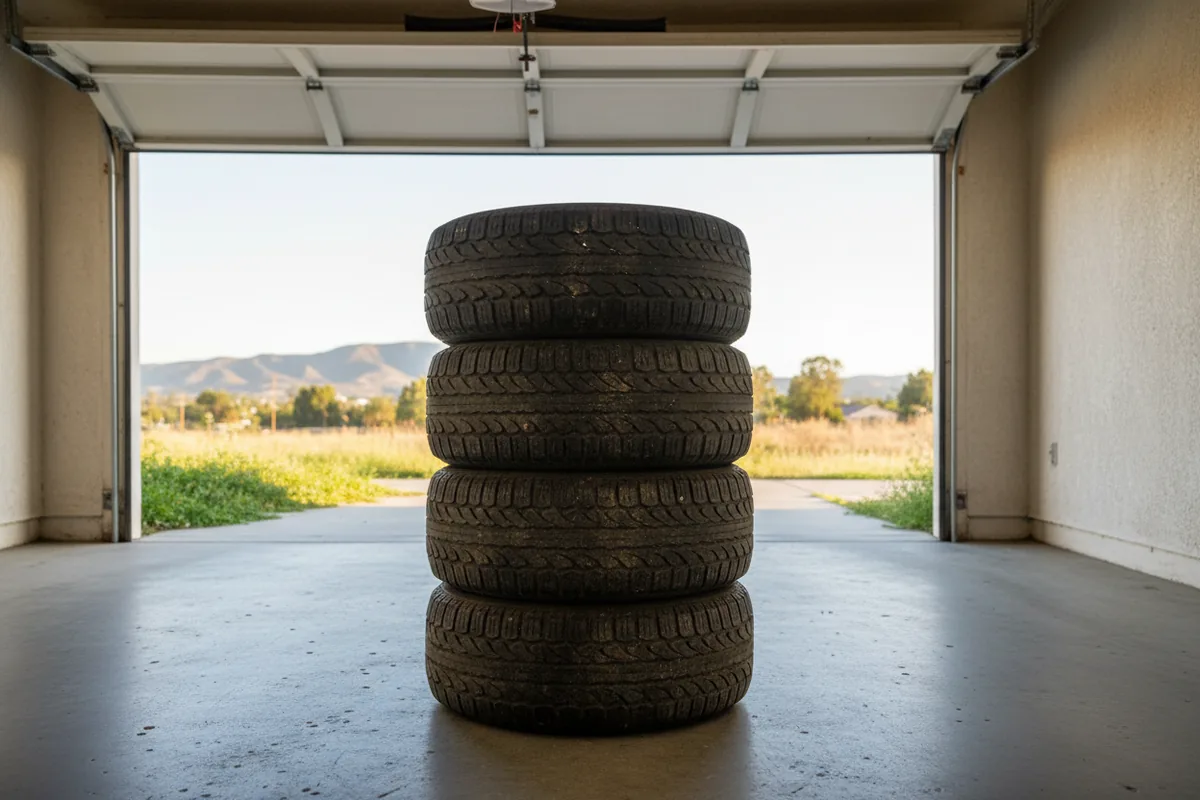
In San Diego County, old tires from a garage, yard or rental usually leave through one of three routes: a tire retailer that takes used tires back, a public drop-off program, or a hauler that includes tires in a pickup. Tires are handled apart from ordinary trash. The right route depends on the tire count, their size and whether rims are attached.
On this page
What Tire Disposal Covers
A waste tire is a tire that is no longer used on a vehicle and is being thrown out. Tire disposal covers every step from storage to a place that accepts the tire: sorting, carrying, loading and transport.
The type of tire matters at each step, and most tires fall into one of three groups:
- Passenger tires, from cars, minivans and small SUVs.
- Truck tires, from light trucks up to commercial trucks, which are larger and heavier.
- Off-road tires, from tractors, equipment and similar machines.
A receiving site may take one group and not another, so knowing which group your tires belong to is a useful starting point.
When Tire Removal Makes Sense
Tires tend to pile up in a few familiar ways:
- Accumulated tires at a home or a rental, kept as spares and never used.
- Garage, estate and property cleanouts, where tires are one item among many. The garage and home junk removal work around them follows the same steps.
- Tires left behind by a previous tenant or a previous owner.
Each of the three routes comes with its own conditions. A retailer or auto shop often takes used tires when new ones are bought. A drop-off program sets its own terms. A hauler can fold tires into a larger junk hauling load along with everything else. Which route is open to you depends on the tire type, the quantity and where in San Diego County the property sits. Clearing tires from a property is a separate matter from any decision about the property itself.
Tires as a Special-Handling Item
Tires sit in a category of their own. They are not ordinary trash, and they are not household hazardous waste (leftover paint, chemicals and similar products collected through a dedicated program). They are a special-handling item: a material that goes to receiving sites that set their own terms for it.
Two details usually decide whether a site will take a given tire:
- Rim status. A tire still mounted on its metal wheel may be treated differently from a bare tire, and some sites take only rim-off tires.
- Size and group. Passenger, truck and off-road tires may be accepted on different terms or at different sites.
Whether a retailer takes tires back, and on what conditions, is for the retailer to state. A quick question before loading tends to settle it.
What Affects the Cost of Tire Disposal
When you ask for a written quote, a handful of factors shape the number:
| Factor | Why it matters |
|---|---|
| Number of tires | Tires are usually handled one by one, so the count drives the work. |
| Size and type | Truck and off-road tires take more handling than passenger tires. |
| Rims on or off | Mounted tires may cost more to process at the receiving site. |
| Where tires are stored | A deep garage, a basement or a fenced side yard adds carrying. |
| Where the tires go | Each receiving site sets its own terms and charges. |
The factors behind junk removal pricing follow the same logic for mixed loads.
Getting Ready for Tire Pickup or Drop-Off
A little information gathered up front makes the phone calls shorter and the loading smoother:
- The count. It is the first thing any site or hauler asks about.
- Rim status. A note of which tires are still on wheels.
- The sidewalls. The size printed on each tire shows whether it is passenger, light truck or commercial.
- Acceptance. Whether the retailer, program or hauler takes these tire types.
- Limits. Drop-off programs may cap how many tires they take per visit.
- Access. Garage depth, stairs, gates and parking all shape a pickup.
These same details also make the rest of a cleanout easier to describe, as the guide to how junk removal works explains.
Common Tire Disposal Mistakes
A few missteps tend to lead to a wasted trip or a returned load:
- Tires in a curbside bin. Tires go through separate channels, and the collection rules for the property decide what its bins take.
- Tires on a roadside or a vacant lot. Dumping is not a disposal route, and state law sets consequences, not only the city or county: Penal Code §374.3 makes dumping waste on a road, on public property or on private property without the owner's consent unlawful, provides mandatory fines on conviction and doubles the fine when the waste was used tires.
- Assuming every retailer takes every tire. Take-back terms vary by store, tire type and quantity.
- Driving to a site that turns tires away. A site's current accepted-materials list answers this in advance.
- Long outdoor storage. Tires collect rainwater and debris, which makes the eventual cleanup harder.
Once you know the tire count and rim status, the receiving program's own page is where acceptance can be confirmed before the tires go in a vehicle.
Ready for a quote?
Add the items, the address and your timing.
Get my junk removal quoteFrequently asked questions
Can I put old tires in my curbside recycling bin in San Diego?
Tires go through separate channels rather than ordinary bins. The collection rules for the property, set by the city or the trash service that serves it, state what its bins accept. A retailer, a drop-off program or a hauler is the usual route for tires.
Where can I drop off tires in San Diego County?
Beyond retailers and haulers, public drop-off programs are the main option. The county or city program page lists current locations and terms, and each site confirms what it accepts.
How many tires can I drop off at a time?
Limits vary by program and by retailer, and some cap the number of tires per visit. The receiving site states its own limit, so a call or a look at its current page before loading avoids a turned-away trip.
Does it cost more to dispose of tires that still have rims?
It may. Some sites accept only bare tires or charge differently for mounted ones. The receiving site or the hauler confirms how rim-on tires are handled, and a written quote reflects it.
Do tire retailers in California have to take my old tires?
Take-back terms are set by the retailer. Conditions such as buying new tires, the tire type or the quantity may apply. The retailer confirms its terms before the tires are brought in.