The table might sit in a game room in Chula Vista, a garage in El Cajon or a basement in an older San Diego house. It might belong to you, to a tenant who moved out, or to a relative whose home is being cleared. Whatever the setting, three things decide how it leaves: how heavy the slate is, how tight the path to the door is, and where each part goes afterward. This page takes those three in order, then covers what to set aside and what to check before anyone arrives.
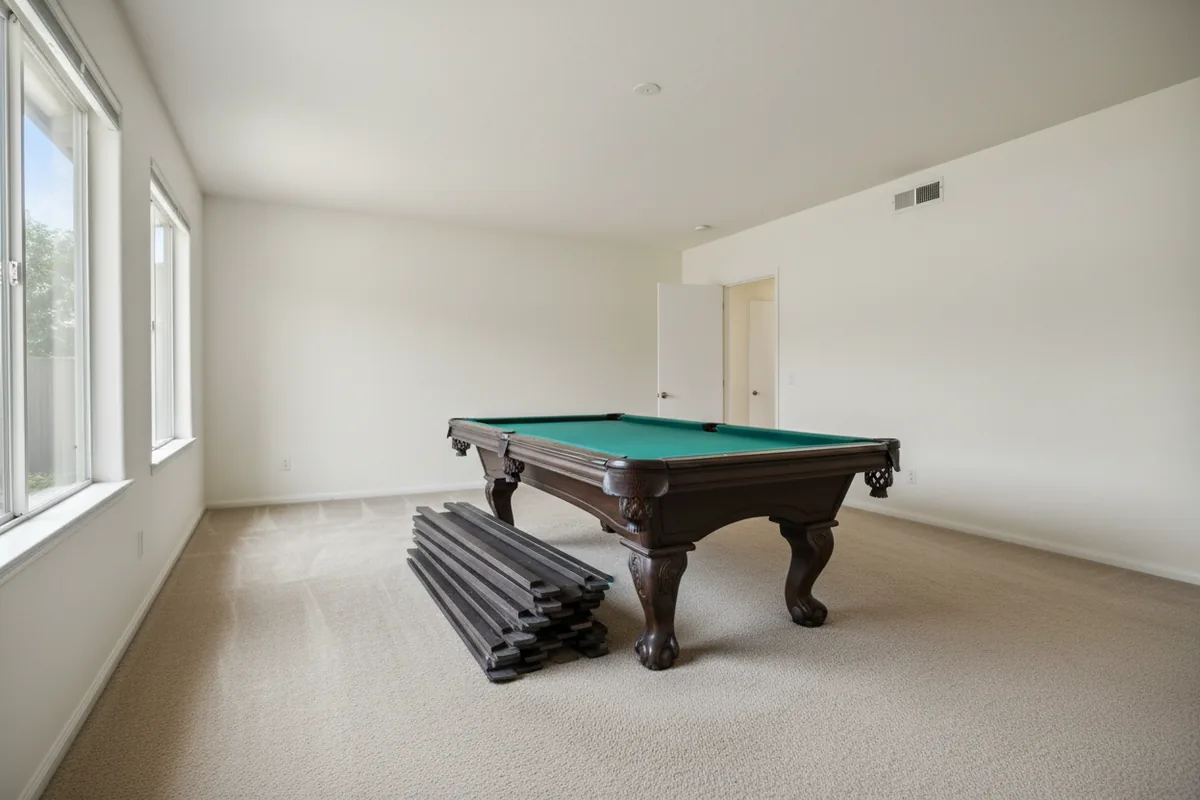
A pool table in a San Diego County home is usually hauled away in pieces, not whole. The felt, rails and pockets come off first. Then the slate is lifted out, and the frame and legs are taken apart. Each part is carried out separately and loaded for disposal or another use. A written quote sets out the cost.
On this page
What Pool Table Removal Covers
Pool table removal means taking a pool table apart into its components and hauling those parts off the property. It differs from relocation. A removal ends when the table leaves the property. A relocation ends when the table is set up and leveled somewhere else. Removal is one kind of junk removal, the general service of clearing unwanted items from a home or business and hauling them away.
Slate tables need the most care. Slate is a dense natural stone used for the playing surface. A slate top weighs a great deal and can crack if it is dropped, flexed or carried at an angle. That weight shapes how the job is planned, how many hands it needs, and how the pieces travel through the house.
A slate table generally comes apart in this order:
- Felt (cloth): stapled or glued to the slate and the rails, and pulled off first.
- Rails: the cushioned edges, unbolted from the frame.
- Pockets: the leather or plastic pockets, or the ball-return parts, detached from the rails or the frame.
- Slate sections: unscrewed from the frame and lifted out, either as one piece or as three.
- Frame: the wooden body that holds the slate, separated into its parts where it is built that way.
- Legs: unbolted from the frame.
Breaking the table down this way is what usually lets the slate get through doorways, down hallways and up or down stairs without damage to the stone or the house.
When Pool Table Removal Makes Sense
Removal tends to fit when the table's useful life is over or nobody has claimed it. Common situations include:
- The slate is cracked, or the frame is warped or damaged.
- The felt is worn, and recovering the table is not worth it to the owner.
- The table is an older or low-value model.
- The room is being turned into an office, gym or bedroom.
- A home or rental unit is being cleared at turnover or after a move.
A table in good condition has other possible routes. A friend, a relative, a resale buyer or a donation recipient may want it, and those routes are worth asking about first. A landlord, property manager or executor clearing a unit may turn to removal when no one has been found to take the table. What happens to the property afterward is a separate decision from clearing it.
Condition is not the only thing that adds work. A table in a basement, or in a room with narrow doors or a staircase, makes the job more involved even when the table itself is in fine shape.
Items and Materials That Need Special Handling
The parts of a pool table are not all handled the same way, and slate is what sets this job apart from ordinary furniture removal.
| Component | What makes it different | Who confirms where it goes |
|---|---|---|
| Slate | Heavy and brittle; comes as one piece or three; cracks if mishandled | The facility that receives it |
| Felt or cloth | Usually torn or worn by the time of removal; usually discarded | The receiving facility |
| Wood frame and legs | Large wooden parts that may be handled as wood waste or as bulky material | The local disposal or wood-waste facility |
| Metal hardware | Bolts, brackets and fasteners; may go with scrap metal or with general waste | The receiving facility |
A bulky item is a large household item that does not fit in a regular trash cart. Whether a city program in San Diego County treats a pool table as a bulky item is up to that program to state. For that reason, this page describes a pool table simply as a large, heavy item that is usually hauled rather than set at the curb.
Where each component ends up depends on its condition and on what the receiving facility accepts. Neither the table's owner nor a hauler decides that alone. The general items that California and city rules keep out of the trash are described on the San Diego junk removal overview.
What Affects the Cost of Pool Table Removal
This page gives no dollar figures; the cost of a specific job is set out in a written quote. The general logic behind quotes is laid out in junk removal pricing. What follows is what that quote is built from.
| Factor | Why it matters |
|---|---|
| Table type and size | A one-piece slate top is heavier and harder to move than a three-piece top. A 9-foot table involves more material than a 7-foot table. |
| Access | A ground floor, a basement and an upper floor each involve different work. Doorway and hallway widths, the number of stairs, and the distance to the curb or truck all affect the effort. |
| Disassembly complexity | A table that has been modified or refinished, or that uses non-standard hardware, takes more work to take apart. |
| Disposal method | Landfill tipping fees, recycling or wood-waste facility charges, and the logistics of a donation drop-off each affect the total. A tipping fee is the charge a facility sets for accepting a load. |
| Location in San Diego County | The distance from the property to the receiving facility matters, and each facility sets its own charges. |
Other items hauled in the same load also change the quote. A table cleared alongside old furniture from the same room is priced as one job, not two.
How to Get Ready for Pool Table Removal
Preparation mostly comes down to two things: space around the table and a known route out. The broader steps of a pickup are described in how junk removal works.
- Space around the table. Chairs, bar stools, wall decor and anything else within arm's reach on every side can be moved out of the way first.
- The path to the exit. Doorway widths, hallway lengths, the number of stairs and any tight turns are useful to measure and note.
- The accessories. Cue sticks, balls, the triangle rack, chalk and the brush are separate from the table and are not automatically taken with it.
- A plan for each accessory. Each one can be marked to keep, to donate, or to go out with the table.
- Basement stairs. A clear stairway helps, and low ceilings or tight landings are worth noting.
- Building or association rules. A homeowners association or building management may require notice, or set rules for moving large items through common areas or elevators.
The details that matter most for planning are the table's floor, the number of stairs, the narrowest doorway on the route, and whether the table has ever been taken apart before. A short written note of these, along with a photo of the table and the route out, puts them in hand when a quote is requested.
Common Mistakes
Most pool table jobs that run long trace back to a handful of assumptions made before the day of removal. Each one is easy to catch with a little checking.
- Assuming the table can go out whole. An assembled frame with its slate rarely fits through a standard doorway, so taking it apart is usually part of the job from the start.
- Booking a general mover without asking about slate. Not every moving company is set up to take slate tables apart, which makes it a question worth asking directly when comparing options.
- Leaving accessories mixed in. Sorting cues and balls in the middle of disassembly slows the work and risks losing something the owner meant to keep.
- Overlooking building or association rules. Some properties require notice, or limit large-item moves to certain hours or exits, and finding that out on the day can stall the job.
- Counting on curbside pickup. Pool tables are large and heavy, and a bulky-item program may set size or weight limits. The relevant city or county program confirms whether a pool table qualifies. How a hauled load compares with curbside routes is covered under junk hauling.
Ready for a quote?
Add the items, the address and your timing.
Get my junk removal quoteFrequently asked questions
How heavy is a 9-foot slate pool table?
A 9-foot slate table is very heavy, and the slate accounts for most of that heft. The exact total varies by manufacturer and by slate thickness. That is why the size of the slate, and whether it is one piece or three, is part of planning the disassembly and the haul.
How much does it cost to remove a pool table in San Diego?
The factors tend to stack. A three-piece slate table on a ground floor with a short, wide path to the truck sits at the simpler end. A one-piece slate top in a basement, reached by stairs and narrow landings, with a longer haul to the receiving facility, sits at the more involved end. A written quote turns that combination into a number for a specific job.
How do you remove a pool table from a basement?
The table is taken apart into its slate sections, frame, legs and rails, so each piece can be carried up the stairs. The number of stairs, the ceiling height and the width of each landing shape the plan. Noting those details ahead of time helps a hauler assess the job accurately.
Can a pool table be picked up as a bulky item in San Diego County?
That depends on the program. Where a city offers a bulky-item program, it may have size or weight limits. The city's or the county's own program confirms whether a pool table qualifies.
Do I need to disassemble the pool table before the hauler arrives?
Typically not. Taking the table apart is part of what a pool table removal job covers. Confirming this when requesting a quote avoids misunderstandings, especially when the table is in a basement or on an upper floor where access is tight.
What happens to a pool table after it is removed?
That depends on each part's condition and on what the receiving facility accepts. Components may go to a landfill, a wood-waste or scrap facility, or a donation recipient. The hauler or the facility confirms what is accepted, and no particular outcome is assured.
Can I donate a pool table instead of having it removed?
Sometimes. A recreation center, school or resale organization may accept a table in good condition. Acceptance depends on the table's condition and size, and on whether the recipient has room for it and a way to receive it. Removal fits when the table is damaged or no recipient is found.